Binary Trees
A tree which can have a maximum of two children is called a binary tree.
Types of binary trees
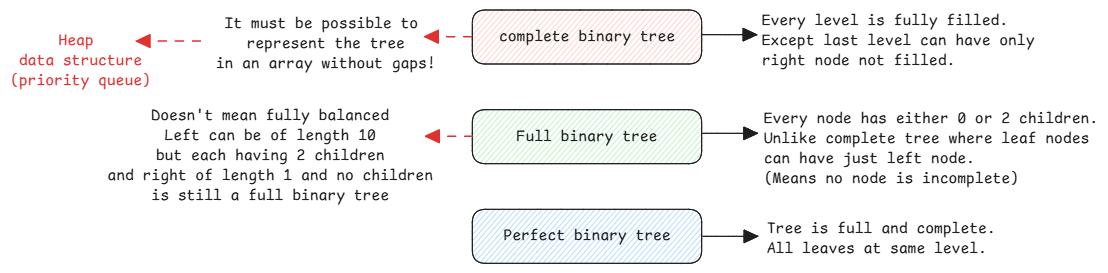
Consider the name full and then we can relate to what a complete binary tree means. Here full means nothing incomplete or partial.
When it's complete, it means there are no any empty spots when we put the tree into an array.
Binary Search Trees
Binary tree only mandates that the each node can have at most two children. Whereas, binary search tree additionally ensures the values of the child must be in a specific sequence in comparison with the parent.
In this data structure, there is nothing about the shape of the tree. It's only about the values each node can hold. The ancestor nodes control and decide what values the descendant nodes can have.
- Left child will have a value lesser than the parent.
- Right child will have a value greater than the parent.
This is the only requirement. This makes it easy to search for a value in the tree.
Depending on the implementation, one side of the tree will have value equal to the parent node.
Even if a tree has just right or left children for any number of levels, it's still a valid tree as long as the values follow the binary search tree rules.
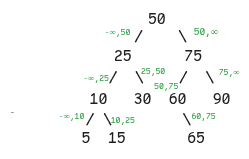
As we can see in the above image, the right side always has by default a minimum value limit and the left side always has by default a maximum value limit.
Inorder DFS traversal of a binary search tree will always give the values in sorted order.
Binary Search Tree Manipulation
In a binary search tree, the successor of a node is the next higher value in the tree. and predecessor of a node is the next lower value in the tree.
-
Successor of a node is always the last leftmost node of the right sub tree. This means, the one with the
node.left == null. -
If a node must be deleted, then the successor of that node must be moved/copied to the position of the node that must be deleted. Then to maintain the binary search tree we must delete the successor node from its original position.
In the below example, if we say we must remove the node 26,
then the left of 30 is assigned with the right sub-tree of 26.That's all.
Understanding this left to right shift is confusing at the first attempt,
but you see that the sub-tree is still on the right but moved to the left of the parent.
30.left = 26.right. By doing this, we're also de-referencing 26 out of the tree.
Original sub tree:
    30
   /
  26
    \
     27
       \
        28

Final sub tree after deleting node 26:
   30
   /
  27
    \
     28
Binary Search Tree Rules
- Left sub-tree < node < right sub-tree
- Inorder traversal is sorted
- Minimum = leftmost node of the entire tree
- Maximum = rightmost node of the entire tree
- Successor = minimum of right sub-tree
- Predecessor = maximum of left sub-tree