RSA
RSA is a mathematical algorithm that's used for encryption and digital signatures.
- Digital Signatures - Hash of the text is signed using one key. The same is done on other side using other key. The values must match.
- Encryption - The actual value itself is signed by one key. The other key is used to get back the original value.
In case of digital signatures, the private key is used to sign and public key is used to verify.
Where as in case of SSL, the public key is used to encrypt and private key is used to decrypt.
In SSL and SSH, only the handshake uses this algorithm. The actual data is encrypted using symmetric encryption. A secret key is exchanged during the handshake and that key is used to encrypt the data.
Mathematics
RSA uses exponential modulus. The actual data is exponentially multiplied on a modular clock. When the same base is multiplied with different values on a modular clock, they land on the same number.
This is the trick used by RSA to ensure that the exact combination of private and public keys is necessary to land on the same location in the clock.
The mathematical operations happens at two phases.
- During the key generation
- During encryption and decryption and also during signing and verification.
The main mathematical process is to run exponential of the hash value on a modular clock.
- Locking - run the modular exponentiation of the hash value with the private key on a modular clock.
- Unlocking - take this result and again run the modular exponentiation with public key on the same modular clock.
They're nothing but numbers. It's written in files in hexadecimal format.
Mathematics on text?
The encryption and digital signatures are all performed on textual data. Actual text data is represented as numbers. The numbers are then used in the mathematical operations.

Number in the protocol name
The number is the protocol name refers to the size of the modulo number.
The size is chosen first, as a design decision, and then the primes are picked to fit it.
Decide the key size, for example 2048 bits. Generate two random primes of half that size: 1024 bits each. Multiply them. The product comes out with 2048 bits.
Euler Theorem
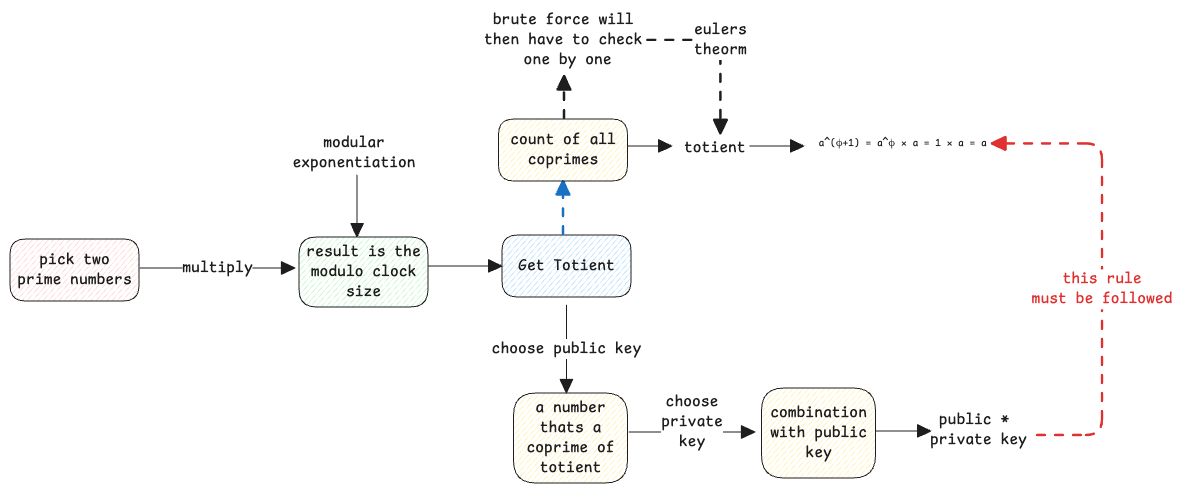
- For a value N, all coprime numbers of N are counted. This count is called the Euler's totient of N.
- If number a and N are coprime, then a^φ(N) leaves remainder 1 when divided by N.
co-prime - Two numbers are co-prime if they don't have any common factors except 1.