Inference Engines
GPU isn't mandatory to host models.
When GPU doesn't exist, the inference runtime can also use CPU itself. It generates CPU instructions for matrix operations.
CUDA is mentioned by default. It's just a wrapper for sending tasks to NVIDIA GPUs. Similar to CUDA, Apple has Metal APIs.
LLM Models generate one single next token at a time. It's the inference engine that keeps appending this newly generated token to the context. It calls the model again until the EOS token is received. This loop is what the inference engine implements.
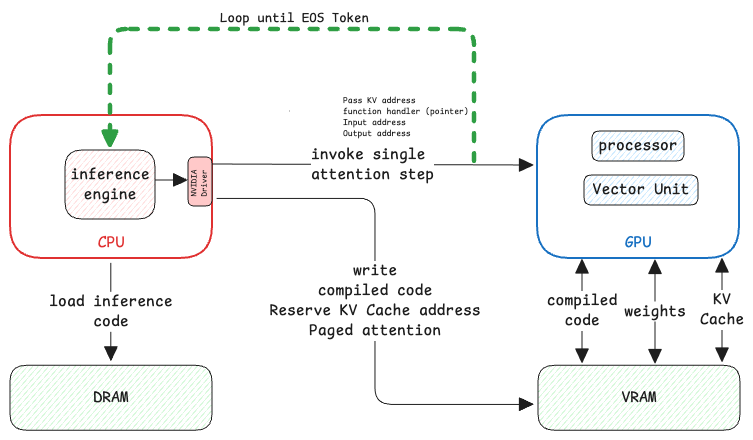
Separation of concerns
It's important to understand which role is performed by which part of the inference chain. This is exactly why a model produced by training on one platform can be used by different inference engines on different platforms.
Below we see example for KV cache and MTP implementation.
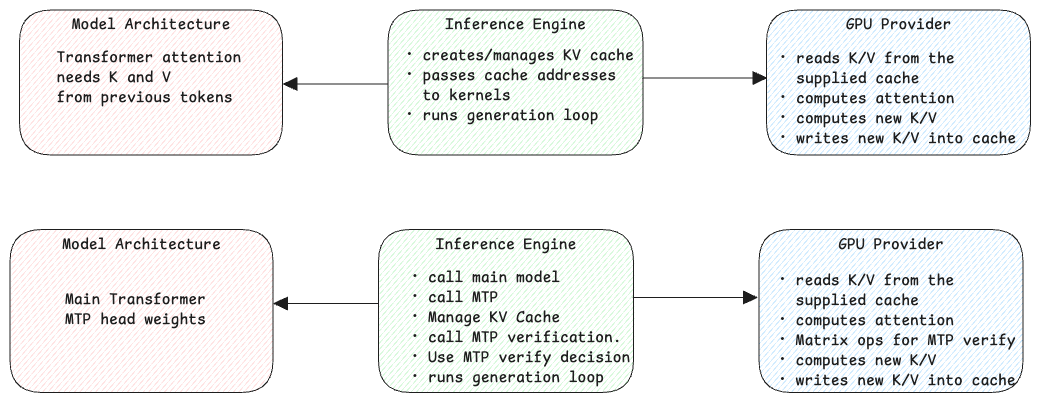
Building Blocks
A model is saved after training. It produces two mandatory artifacts. One is the weights(safe tensors) and other is the model config. The model config/metadata contains the architecture details and which mathematical transformations must be done. Inference engine uses this information to perform the defined steps in runtime.
The model package format depends on different model hosting providers.
For example, hugging face has its own format which contains model.safetensors, tokenizer.json and config.json. Whereas, llama.cpp uses the GGUF format where the entire model is put in a singe file.
Think of the model architecture as the instruction book for a LEGO set. The engine and hardware provide the actual blocks to build it.
Code is compiled for a specific CPU. Similarly, model weights are converted or shrunk (quantized) to run faster on specific hardware.
Paged Attention
Paged attention is inference engine's way of implementing CPU's memory paging for storing KV Cache.
The inference engine grabs one large VRAM pool from the GPU. It splits this pool into small pages and allocates them on demand. The engine maps logical pages to physical memory blocks without touching the model itself.
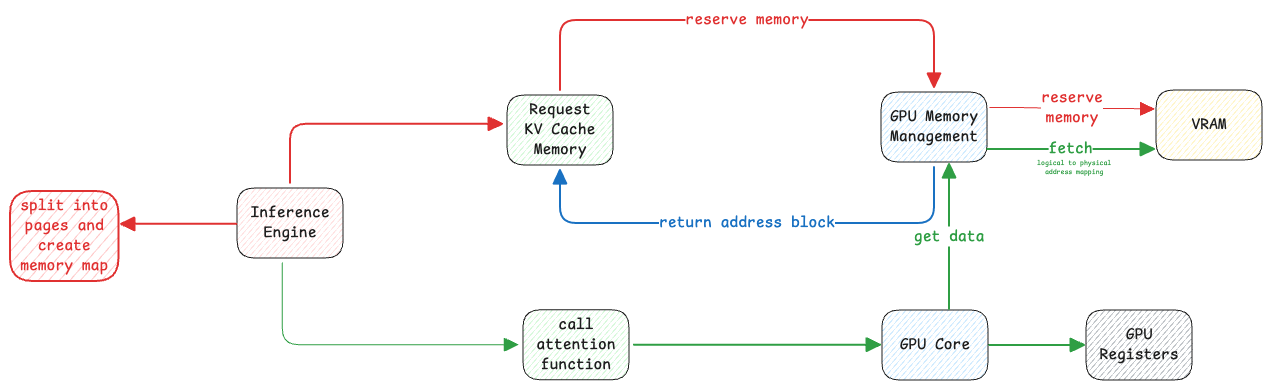
Paged attention isn't a model feature. The GPU provider must provide this feature and the inference then uses it if available.